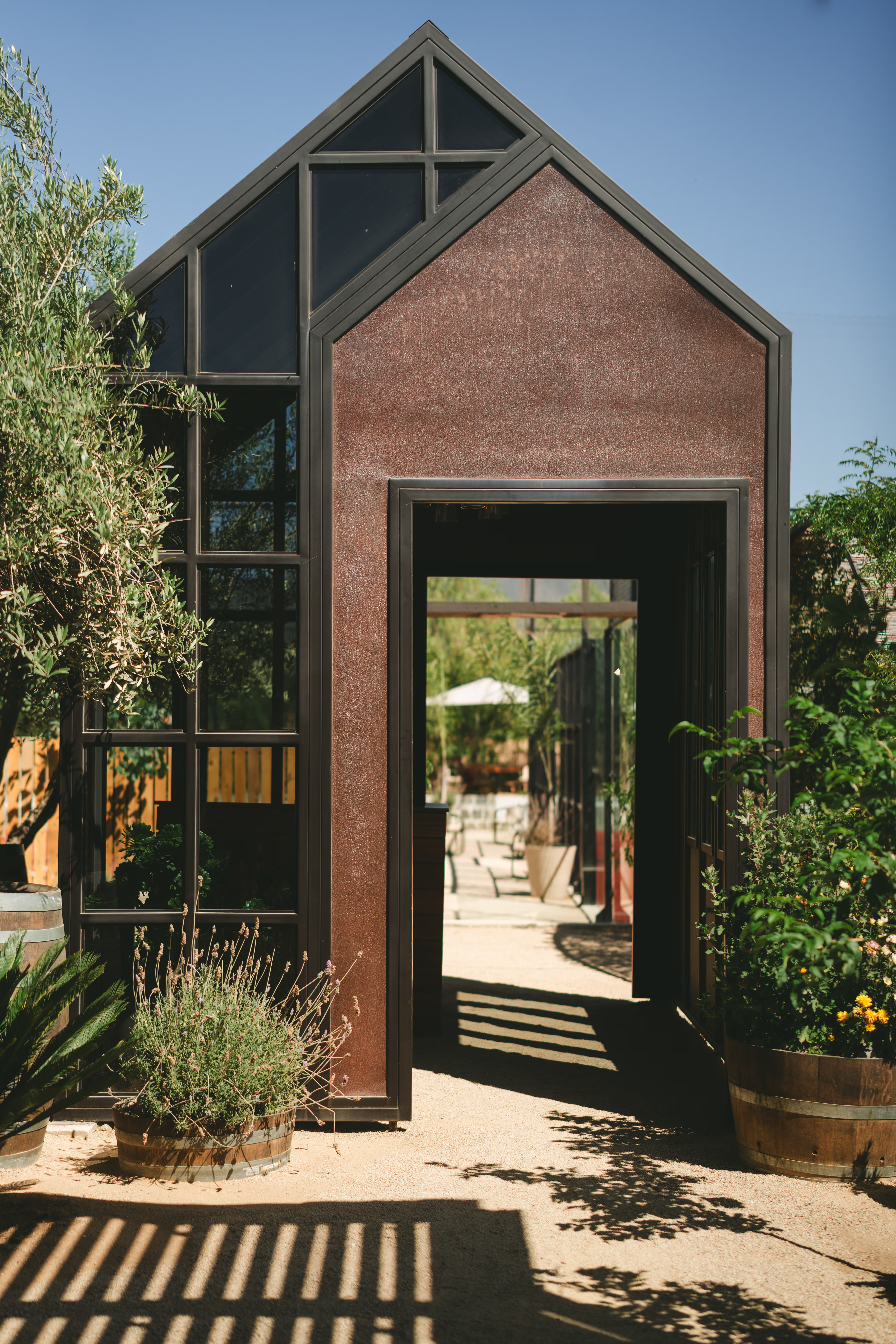
It begins earlier than the table
Most hospitality stories begin at the table.
With a dish.
With a room.
With a moment of arrival.
At Olivea, it begins earlier than that.
It begins in the garden, in the quiet hours of the morning, before guests arrive and before decisions harden into plans. At a time when the pace of the day is still flexible, and the direction of the experience is not yet fixed.
This is not a metaphor.
It is a working reality.
On any given morning, the garden offers information before it offers abundance. Leaves signal stress. Soil retains or releases moisture. Growth accelerates or pauses without explanation.
Those signals are read first — and everything else follows.
A garden that decides
The garden at Olivea is not decorative.
It does not exist to illustrate an idea.
It exists to define one.
What grows — and what does not — determines the menu.
The season determines the rhythm.
The harvest sets limits long before a dish is imagined.
Sometimes a crop arrives exactly as expected.
Other times it does not.
When that happens, the menu changes. Techniques shift. Portions are reconsidered. No announcement is made. The experience adapts quietly, without drawing attention to the adjustment.
Those limits are not obstacles.
They are the framework within which everything else becomes possible.
When you work this way, creativity is no longer about invention.
It becomes an act of listening.
Time as a design decision
There is a tendency in modern hospitality to compress time.
To optimize it.
To move guests efficiently from one moment to the next.
Olivea moves in the opposite direction.
The walk through the garden, the presentation of ingredients in their original state, the progression of the tasting menu — these are not separate moments. They are part of a single narrative that unfolds slowly, without urgency.
Time here is not an indulgence.
It is a design decision.
Without time, origin cannot be understood.
Without time, the relationship between land and plate collapses into abstraction.
Sustainability without announcements
Sustainability at Olivea is not presented as a message.
There are no declarations.
No slogans.
No promises made for effect.
Instead, it appears quietly in decisions that are rarely visible.
How water is used and conserved.
How energy systems are planned for durability rather than efficiency alone.
How cultivation practices prioritize long-term balance over short-term yield.
Sustainability is not something added to the experience.
It is the infrastructure beneath it.
For this reason, it is not announced.
It is practiced.
From observation to action
Every morning in the garden produces information.
What struggled.
What thrived.
What changed unexpectedly.
Those observations do not remain theoretical.
They move directly into the kitchen, into service flow, into the way dishes are composed and sequenced. Adjustments are made in real time, often without discussion, because the system itself already anticipates change.
Nothing remains abstract for long.
At Olivea, ideas are only valuable once they become decisions.
A place to test, not to scale
Olivea was never designed to be replicated quickly.
It exists as a place where ideas can be tested carefully, where systems can be refined over time, and where hospitality can be practiced with attention rather than urgency.
Some ideas work immediately.
Others require seasons to reveal their value.
Some are discarded entirely.
This is intentional.
Olivea operates as a living case study, not a finished model.
Progress here is measured in coherence, not speed.
The structure beneath the experience
What guests encounter at Olivea may feel calm, intuitive, even effortless.
That ease is not accidental.
It is the result of accepting limits, designing with intention, and allowing the garden — not trends, not expectations — to remain the foundation.
The garden is not the backdrop.
It is the structure.
And everything else follows.